Your AI Knows Your Lab Results. Who Else Does?
In this episode
- Personal use, not work, is where Sandy sees AI's biggest use today, so privacy is a household issue.
- Decide what your AI can see, file by file, and keep the right to switch it off.
- Give every agent limits and an end date before it touches money.
- Treat your original ideas like personal data.
- Use AI as a sparring partner, not as the author of your creative work.
- Build governance in from day one.
Most AI demos are about work: faster email, smarter dashboards, leaner teams. Sandy Carter starts somewhere else. On this Edge Live AI Operator Briefing of The Edge of Show, host Josh Kriger sits down with the CEO of EQUS and author of AI First, Human Always to talk about personal AI and data ownership: the AI use nobody demos.
“But, actually, our number one use case for AI in the industry is not work,” Sandy says. It’s meal plans, recipes, things for our kids, a doctor’s notes. Those are exactly the things most of us would rather not hand to a platform. In 30 minutes she shows how she keeps that data private, why an AI agent needs an expiry date, and why your thinking is your identity, not training data.
Key Topics Covered
- Personal use is AI’s biggest use case: Sandy argues the real growth in AI is at home, not at work, and that raises the stakes on privacy.
- “Your data is not our business”: why people should decide who sees their information, when and how, and what the fine print of many AI tools allows.
- Live demo of EQUS X: a personal AI that reads a private file only when you switch access on.
- Agents need limits: scoped permissions and an end date before an agent gets near your bank account.
- Edge Quick Hitters: AI overkill, the decision she would never hand to an agent, her AI bet for small teams, and the secret strong AI operators already know.
Personal AI and data ownership: people want control
Sandy opened with research from her own company. A survey that EQUS commissioned from Propeller Insights (1,034 U.S. adults who use an AI assistant for personal matters, September to October 2026) found that 77% have discussed a personal topic with an AI assistant, and 79% believe they should own and control the information they feed into it. Only 24% believe they actually have that control (EQUS, “What People Really Want From AI: The Personal AI Report”, 27 Oct 2026).
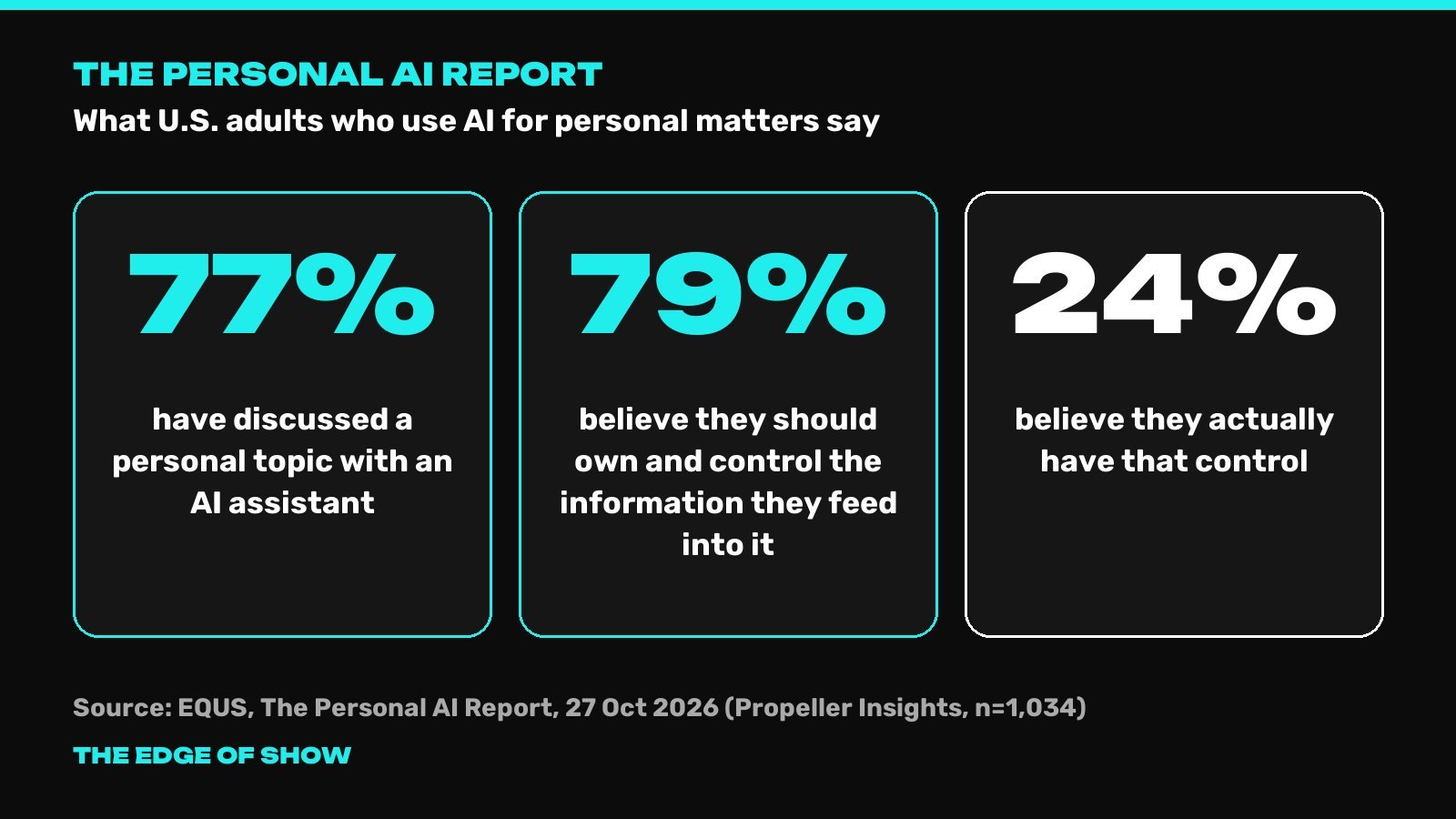
Three numbers from EQUS’s Personal AI Report: the gap between wanting control and having it. Source: EQUS, The Personal AI Report, 27 Oct 2026 (Propeller Insights, n=1,034). Graphic: The Edge of Show
That gap is the whole conversation. Sandy puts the EQUS position in five words, and they are also the company’s tagline:
“Your data is not our business. You should own it and you should decide who gets to see it, when they get to see it, how they get to see it.”
Sandy Carter
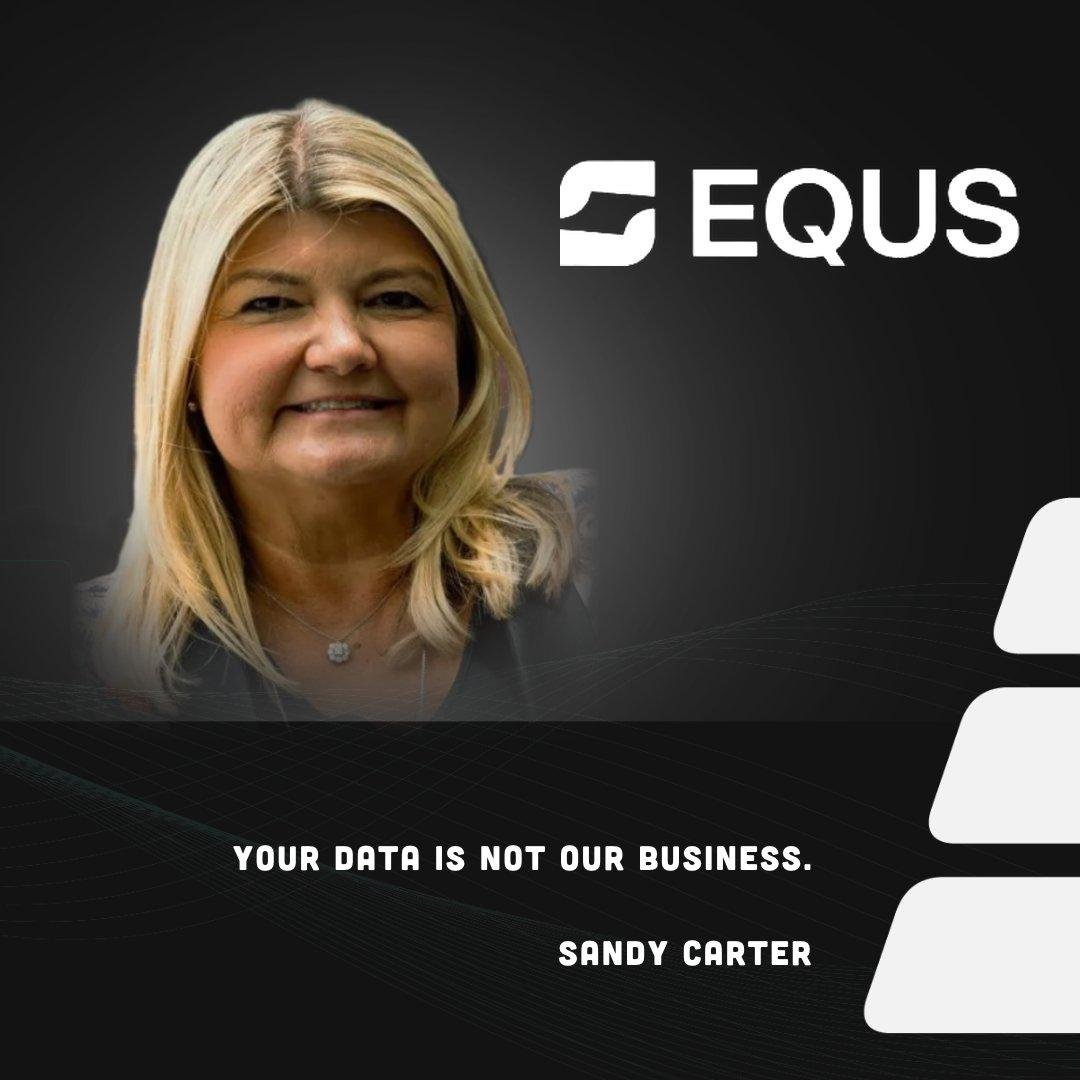
“Your data is not our business.” Sandy Carter on who should control personal data. Image: The Edge of Show
The problem, she says, is that most people don’t know how to protect their data, and many tools don’t give them the choice. Read the terms, and many say your inputs can be used for advertising or training. With AI moving this fast, she adds, nobody is keeping up with the terms, and governance is not keeping up either.
A live look at EQUS X
Then she showed it. EQUS X, which EQUS announced on 5 October 2026, is a personal AI with a private data storage area you control. For the demo Sandy loaded four fictional family files: lab results, a trip itinerary, a home insurance summary and a household budget.
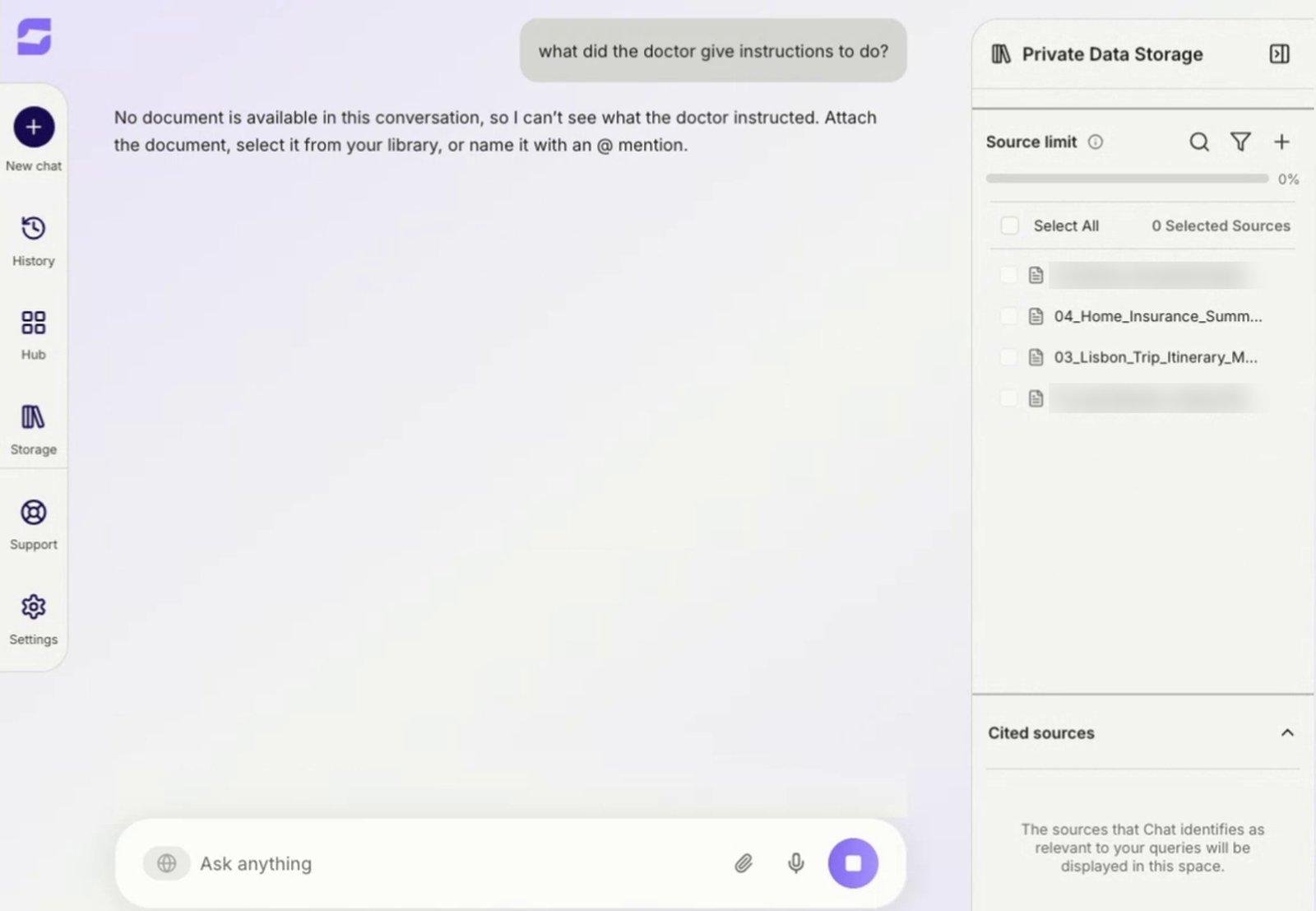
Access off: with no files shared, EQUS X says it cannot see what the doctor instructed. EQUS X live demo on Edge Live (demo files are fictional; names blurred)
With access switched off, she asked what the doctor had told her to do. The AI answered that it could not see her files. She flipped access on for that file, asked again, and it pulled the instructions from the lab report. “It’s not meant to be a chat GPT replacement or a cloud replacement,” she said, but a tool for the data you would never paste into a public chatbot.
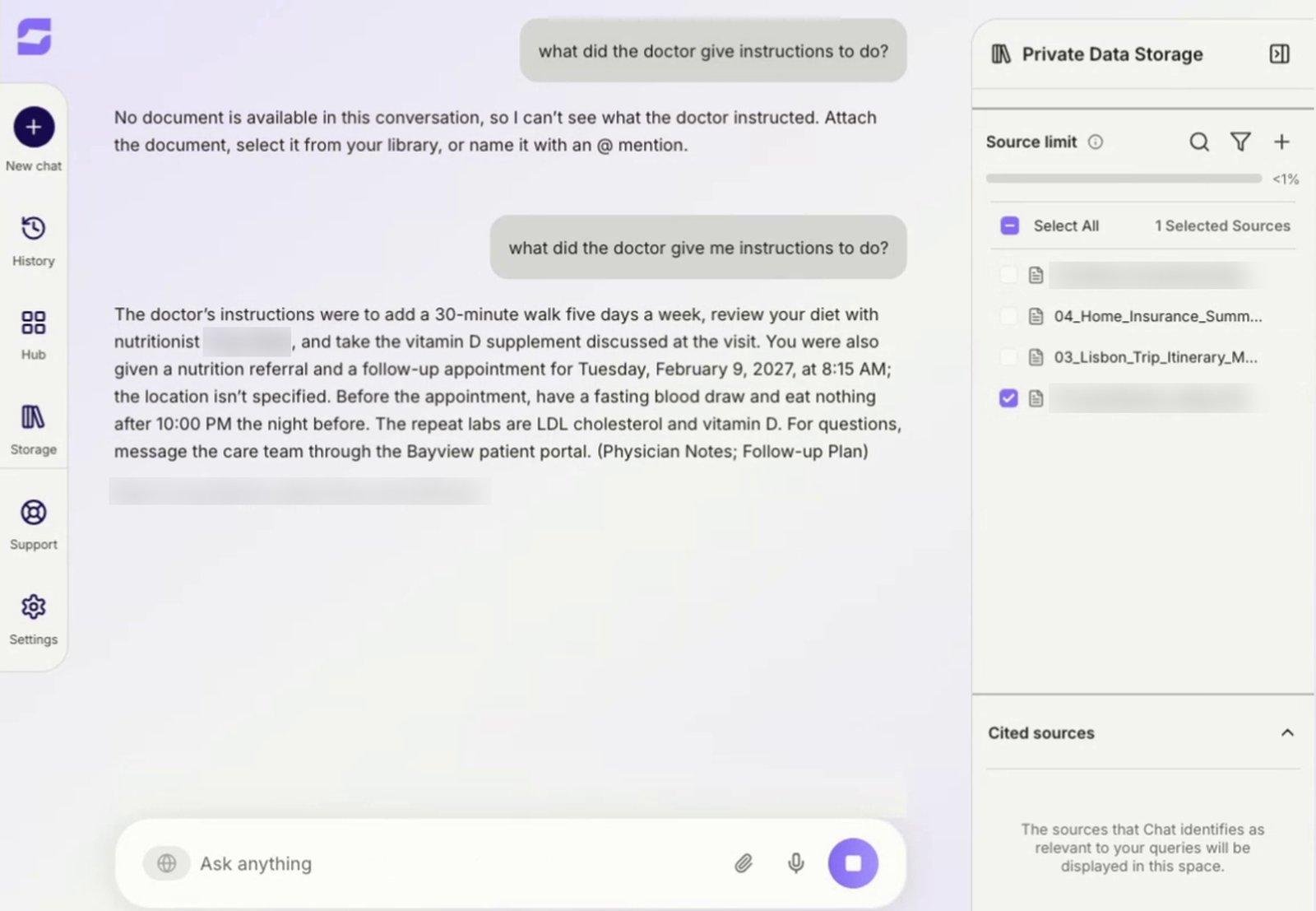
Access on: one file shared, and the same question gets an answer drawn from the lab report. EQUS X live demo on Edge Live (demo files are fictional; names blurred)
“So the power here, Josh, is that I can now use it with AI, get all the benefits of AI, but I’m not losing my data.”
Sandy Carter
She uses it the same way off camera: for the household budget, for trip plans, and for her networking notes. Those notes hold details about other people, she points out, such as a friend’s family illness, and “those people may not want me sharing that information broadly.”
Josh added a lesson from his own life. When he needed to understand medical test results in Spanish, the easiest tool was the one already on his phone. His advice: have a private AI plan in place before you need it.
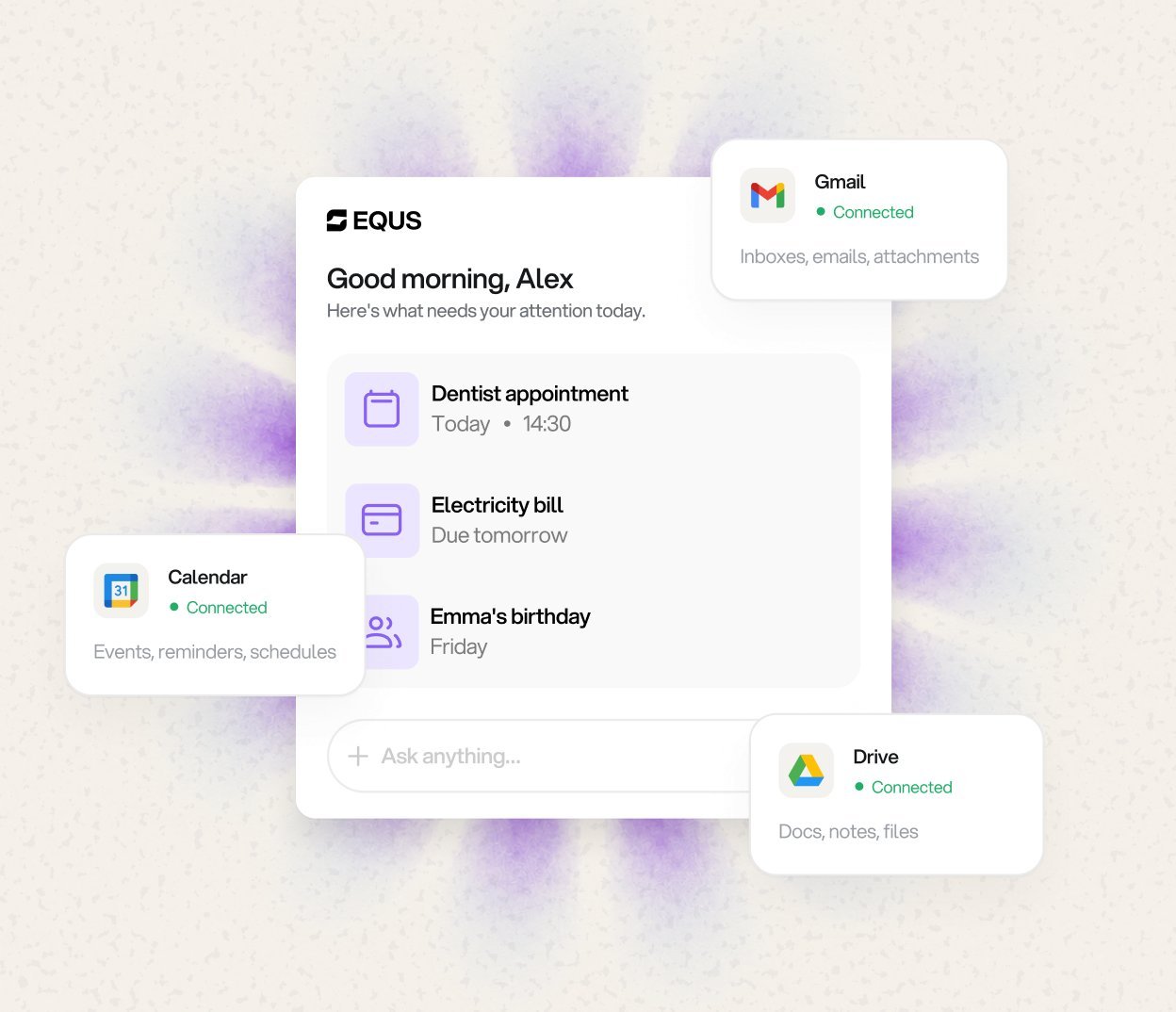
EQUS X pulling your mail, calendar and files into one morning brief. Image: EQUS (equs.ai)
Agents need an end date
Sandy’s warning about personal AI agents came with a story. A friend gave an agent access to her bank account to buy clothes for a vacation, but never told it the vacation was over. “She ended up with 17 bathing suits arriving at her house.” Her point: an agent needs scoped permissions and an expiration date, and people need simple ways to set both. EQUS is working on the technology side of that problem.
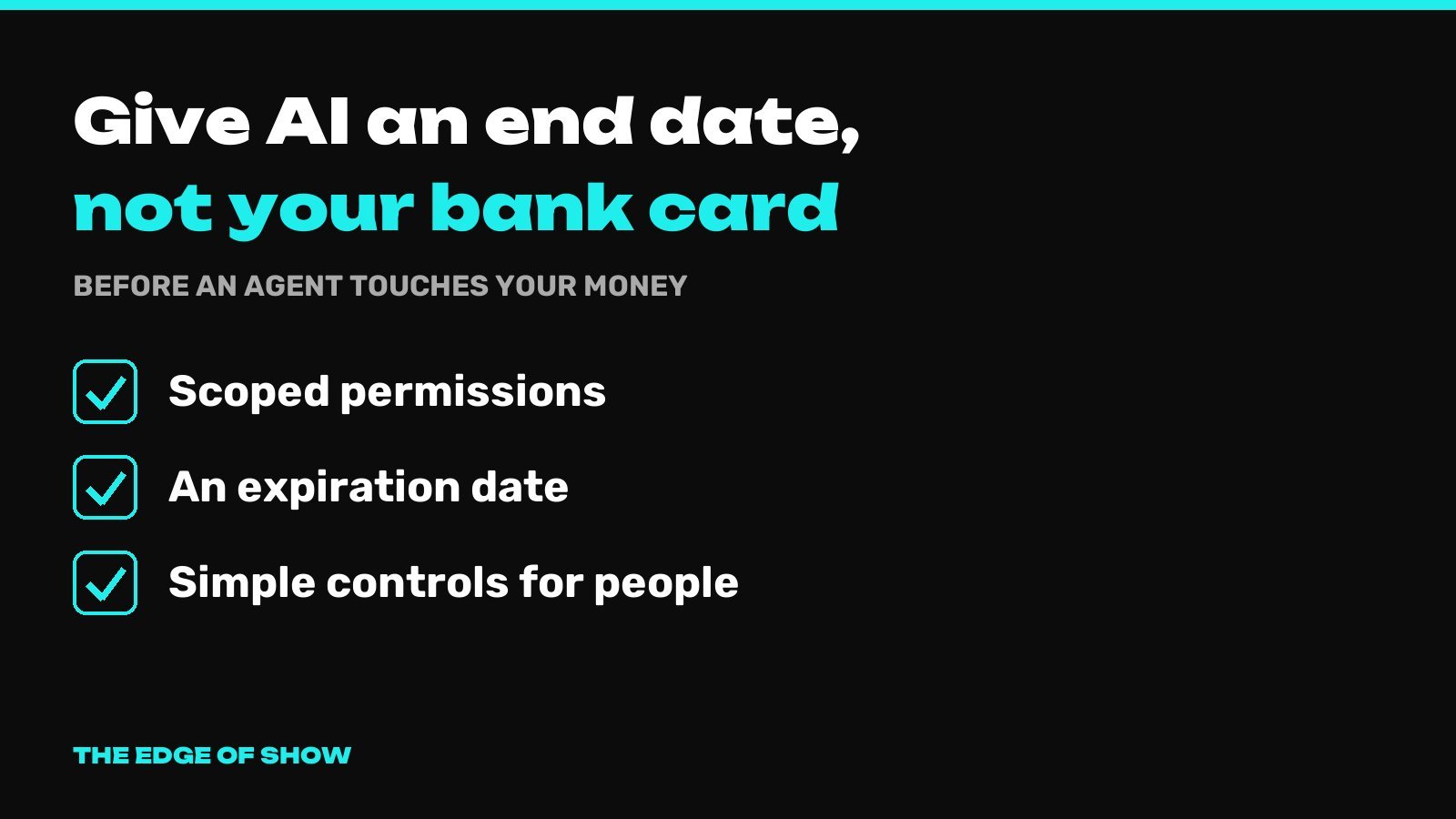
Sandy’s rules for personal AI agents, before one gets near your money. Graphic: The Edge of Show
Your thinking is your identity
The part of the conversation that stays with you is about ideas. Sandy described founders in Silicon Valley who used AI as a sparring partner for a new idea and later felt they saw that idea popping up elsewhere. Whatever happened in any single case, her advice to her own daughters is the same: anything personal, including how you think, belongs in a tool you control.
“I mean, that’s who you are. That’s your identity. You don’t wanna share that and make that a commodity.”
Sandy Carter
Sandy Carter on why your ideas deserve the same protection as your personal data. Image: The Edge of Show
She also sees an upside. In a future “reverse marketplace”, people who own their data could choose to sell it, and be targeted for things that actually matter to them. Josh sees the same trend from the business side: data licensing, by companies and individuals, is one of the next big questions in AI.
Edge Quick Hitters
- AI overkill: write the first email and the first draft yourself, then use AI “as a thought sparring partner, not as the original.” When her daughter reached for Claude to answer a question about her own opinion, Sandy’s reply was simple: “I wanna know what you think.”
- Keeping things human: she would not hand anything creative to an agent, from a logo to a slogan. “Well, when you put stuff into an LLM, it kinda averages everything out.” The result, she says, is sameness.
- Her AI bet for small teams: delegate the automatable work, such as campaign analysis, landing-page A/B comparisons and some customer support, and keep people for the hard problems.
- Her AI secret: put governance in early. Bounded, credentialed agents can feel slower, “but in the long run that is the smart decision to make.”
Sandy Carter on the work she keeps human. Image: The Edge of Show
Key Takeaways
- Personal use, not work, is where Sandy sees AI’s biggest use today, so privacy is a household issue.
- Decide what your AI can see, file by file, and keep the right to switch it off.
- Give every agent limits and an end date before it touches money.
- Treat your original ideas like personal data.
- Use AI as a sparring partner, not as the author of your creative work.
- Build governance in from day one.
Episode Highlights
“But, actually, our number one use case for AI in the industry is not work.”
Sandy Carter
“Now I’m not only sharing information about me, but now I’ve shared information about people I care about, and those people may not want me sharing that information broadly.”
Sandy Carter
“I think there’s a difference between delegating your creativity and using it as a sparring partner.”
Sandy Carter
“So I won’t delegate my creativity, my thought process, my intuition to AI.”
Sandy Carter
“AI is most useful when it works for you on your terms with your data while a person still makes the call.”
Josh Kriger
People and Resources Mentioned
- Sandy Carter, CEO of EQUS
- Josh Kriger, host of The Edge of Show
- EQUS
- EQUS X
- EQUS, “What People Really Want From AI: The Personal AI Report” (27 Oct 2026)
- AI First, Human Always: Embracing a New Mindset for the Era of Superintelligence by Sandy Carter (Wiley, 2025)
- Claude and ChatGPT (named as everyday examples)
- Sandy’s earlier visit to The Edge of Show: Unstoppable Women Leaders in Both Web3 and AI
About Our Guest
Sandy Carter is CEO of EQUS, the privacy-first AI and identity company behind EQUS X, and author of AI First, Human Always (Wiley, 2025). She was previously COO of Unstoppable Domains, a vice president at AWS and a general manager at IBM, and she founded Unstoppable Women of AI. She was named one of the Top 10 AI Entrepreneurs by MSN and Microsoft.
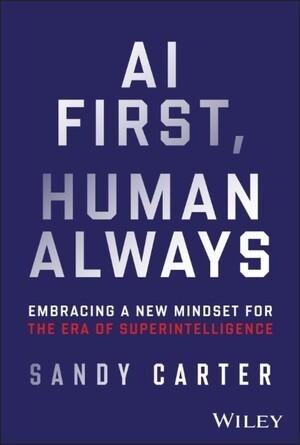
AI First, Human Always: Embracing a New Mindset for the Era of Superintelligence by Sandy Carter (Wiley, 2025). Cover: Wiley
Guest Contacts
- Website: Sandy Carter’s website
- X: @sandy_carter
- LinkedIn: Sandy Carter
- Instagram: @sandy_carterfounder
- EQUS: EQUS website | X @MyEqus | LinkedIn | Instagram @myequs
Watch, Listen, Follow
Watch the full Edge Live episode on YouTube and subscribe to the channel so you never miss a live show. Edge Live streams on YouTube, X and LinkedIn, and every episode drops as a podcast on Spotify and Apple Podcasts. Follow The Edge of Show on X, Instagram, LinkedIn and TikTok, and get every episode in your inbox with The Edge of Show Newsletter. Want to put AI to work in your team, on your terms? Talk to Edge of AI.
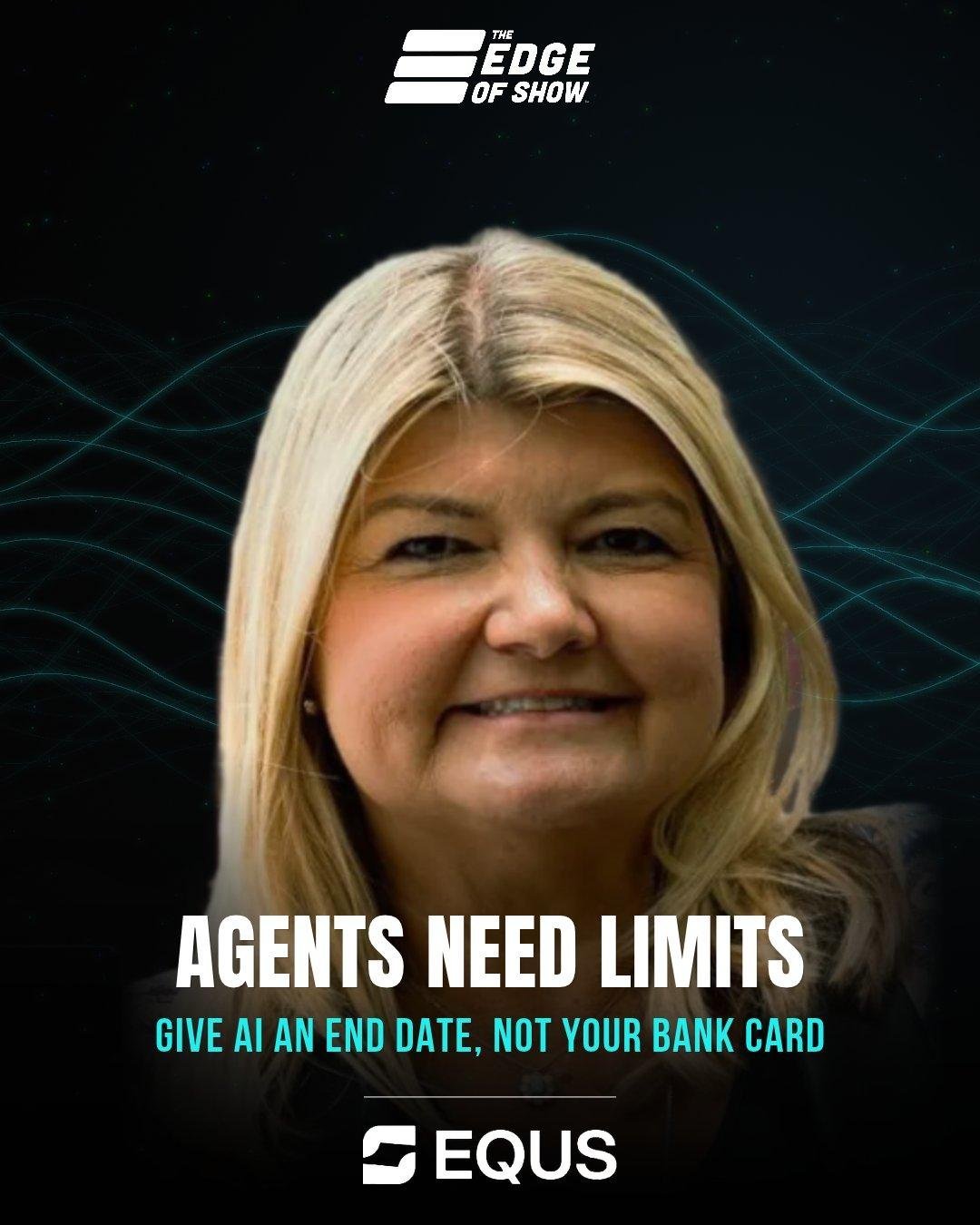
Share it: Sandy Carter on The Edge of Show. Image: The Edge of Show
This is not financial or tax advice. The Edge of Show content is strictly educational and is not investment advice or a solicitation to buy or sell any assets or to make any financial decisions.


